Blog - The latest articles and news
Stay up-to-date with the latest industry news as our marketing teams finds new ways to re-purpose old CSS tricks articles.
Stay up-to-date with the latest industry news as our marketing teams finds new ways to re-purpose old CSS tricks articles.
by Kingdom Kode Team, Digital Innovation

If you've been hunting for the best photos for Google Business Profile, you've already sensed the gap: a 4.8-star listing with 80,000 reviews, fully "complete" on paper — and 5 photos. Sometimes 3. Sometimes the last one was uploaded in 2021. The trust is there. The proof isn't. And Google notices what buyers notice.
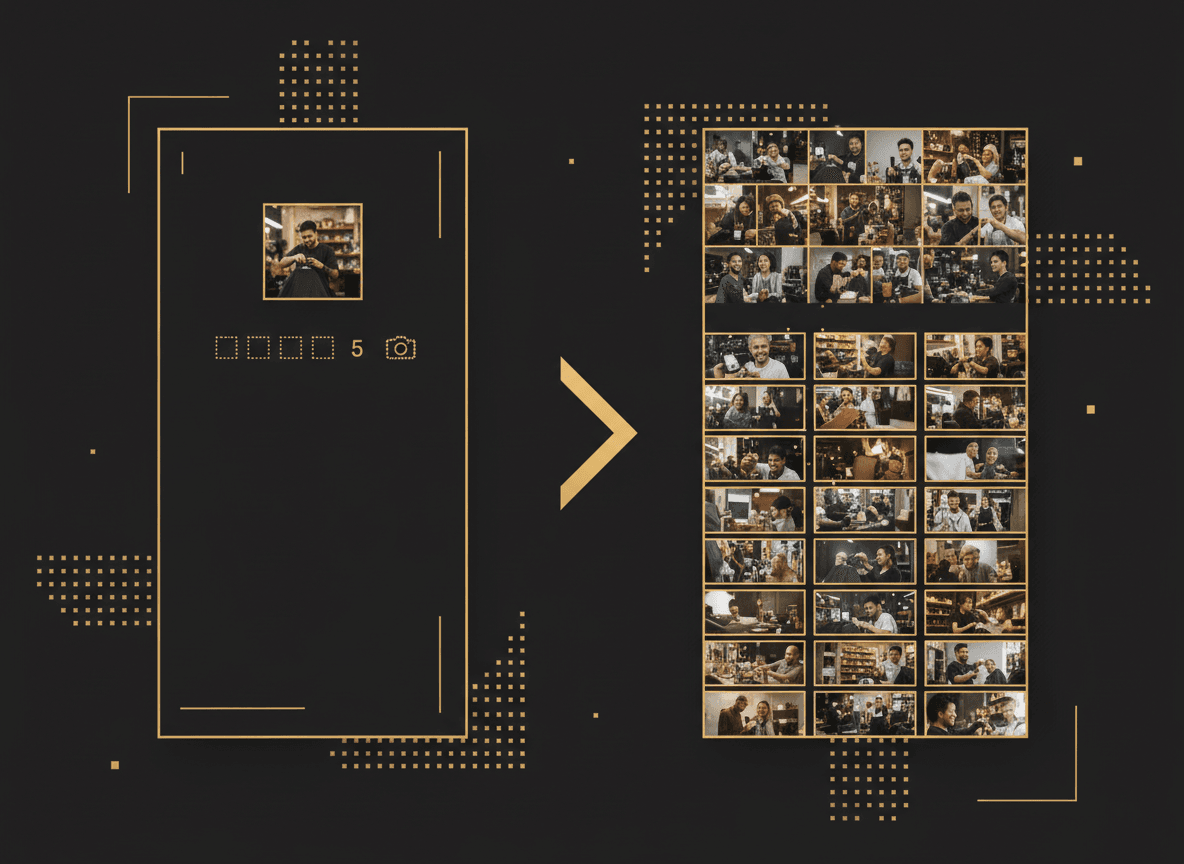
We run diagnostics on local service businesses, and the same pattern shows up on barbershops, salons, and spas that should be crushing it. A near-perfect review profile with almost no media is a Ferrari with a lawnmower engine.
Thin, stale photos are quietly costing you rankings and clicks. Let me show you exactly why — and what to fix.
Two separate engines run on your listing. You need to feed both.
Engine 1: The algorithm. Google favors active, well-maintained profiles. Photos are a signal of a real, operating business. A listing that adds media regularly looks alive. A listing frozen at 5 photos looks abandoned — even if you're booked solid in real life.
Engine 2: The human. A prospect scrolling three barbershops doesn't read your reviews first. They look at pictures. They want to see the fade, the chair, the shop, the person who'll be holding the clippers. No photos of the actual work? They bounce to the shop that shows it.
Here's the trap, framed as a principle. Picture two hypothetical listings side by side: a 5-star, 80k-review listing with 5 photos, and a 4.6-star listing with 120 fresh, specific photos. In many markets the second one wins the booking — because it answers the buyer's real question: will I look good walking out of here? The first one doesn't.
Reviews earn the click. Photos earn the booking.
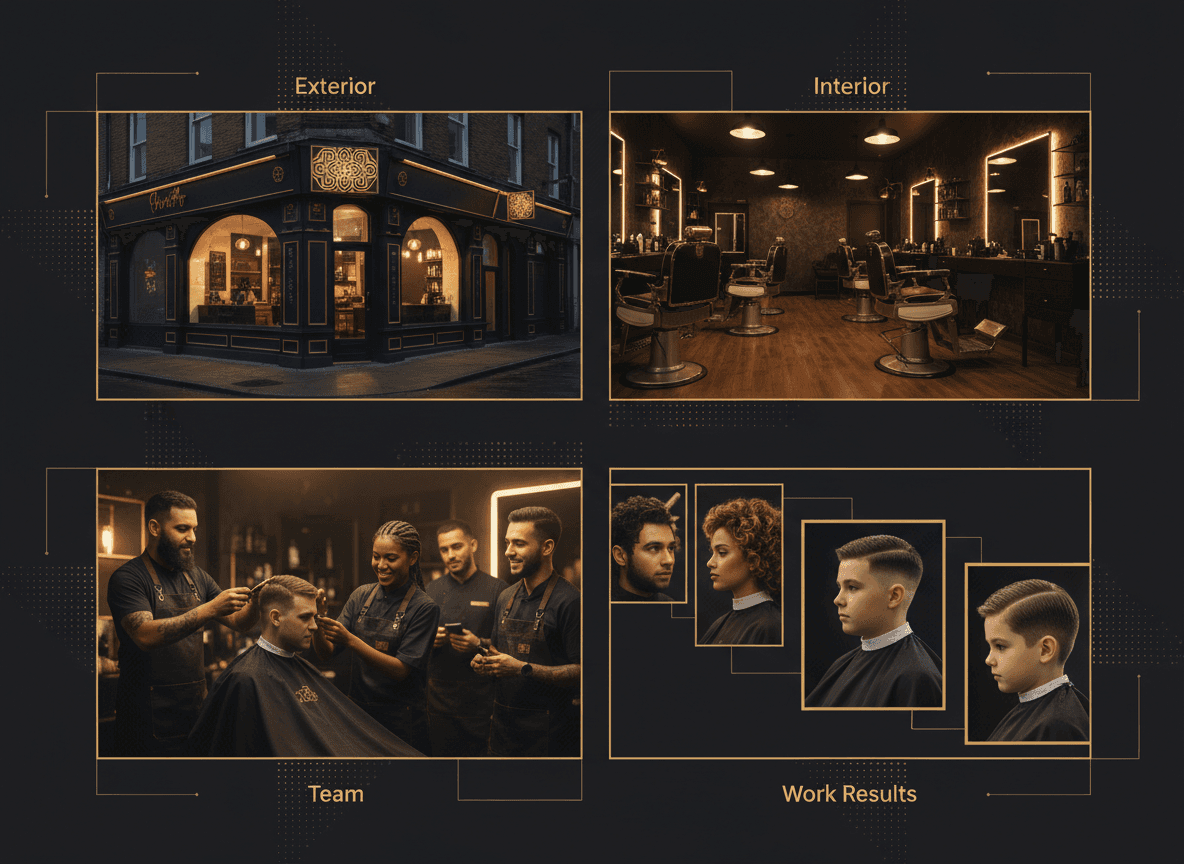
Most owners upload whatever's on their phone. Wrong approach. Buyers make decisions across four distinct categories, and a gap in any one loses a segment of customers.

1. Exterior. Can they find you and park? Storefront, signage, the street view, the entrance at day and night. This kills the "is this place legit / where do I go" anxiety.
2. Interior. What's the vibe? Clean stations, waiting area, the chairs, the lighting. A spa buyer is buying calm. A barber buyer is buying a clean, sharp environment. Show it.
3. Team. Faces. Real people. This is the single most underused category. People book people. A grid of your barbers or stylists — smiling, on the floor — converts better than any stock-looking shot.
4. Work results. The before/afters. The fades, the color, the beard lineups, the plate of food. This is your product. If a restaurant shows 4 dishes and a barber shows 3 haircuts, you're both under-proving. This is where volume matters most.
If you've got 5 photos total, you physically cannot cover four categories with any depth. That's the math of why you're underbuilt.
Stop guessing. Here's the starter set to get from "technically complete" to "converting."
That's 40–60 photos out of the gate — not 5. And it's not a one-time dump.
Here's what separates listings that climb from listings that stall: recency.
A photo from 3 years ago tells Google and buyers nothing about today. Fresh media is a continuous ranking and trust signal. So build a cadence you'll actually keep:
A barbershop doing $30k/mo has enough daily material to post fresh cuts every week for the rest of its existence. The bottleneck is never content. It's a system to capture and post it consistently. That's the gap.
Fixing photos alone will move the needle. But photos sit inside a bigger system: your categories, services list, description, Q&A, review velocity, and — the one that actually prints money — the path from listing to booked appointment.
What's the point of ranking higher and getting more clicks if the click lands on a phone number nobody answers instead of a booking button? The best photos for Google Business Profile get someone to decide. Your booking flow has to close.
That's the full picture: media depth → clicks → a friction-free booking path. Miss any link and the money leaks out. See how we think about the whole stack on the homepage or dig through more breakdowns on the blog.
You can guess at how thin your photos are — or you can see it measured against what's actually working in your market.
Run your free Revenue Code Diagnostic. It scans your Google Business Profile, flags the photo, freshness, and conversion gaps costing you bookings, and shows you what to fix first. No fluff, no sales pitch buried inside.
Your reviews already did the hard part. Don't let 5 stale photos undo them. Run your free Revenue Code Diagnostic — or book a pricing call if you'd rather talk it through.
Most SaaS founders treat the free trial as a waiting room. The ones converting at 25% or higher treat it as a structured sales system. Here is how to build that system.
Read moreA product roadmap tells you what you are building. A revenue engine tells you whether it is making money. Most SaaS founders only have one of these, and it is the wrong one.
Read more