Blog - The latest articles and news
Stay up-to-date with the latest industry news as our marketing teams finds new ways to re-purpose old CSS tricks articles.
Stay up-to-date with the latest industry news as our marketing teams finds new ways to re-purpose old CSS tricks articles.
by Kingdom Kode Team, Digital Innovation

You lost a $9,000 job last week and you don't even know it — and your home service lead response time is the reason why.
A homeowner filled out your form at 8:14 PM. You saw it the next morning at 7:30, called at 9, left a voicemail. By then they'd already booked an estimate with the guy who texted them back in four minutes. You were fully qualified to win that job. You lost it anyway.
Here's the part that stings: you were probably the better contractor. Didn't matter. In home services, the buyer doesn't hire the best plumber, HVAC tech, or landscaper. They hire the one who shows up first and looks like they have their act together.
When a homeowner needs work done, they don't request one quote. They request three or four. Then they sit back and wait.

The first contractor who responds fast and professionally sets the anchor. They get the site visit scheduled. They build trust before anyone else even calls back. By the time competitor two and three roll in, the job is already emotionally sold.
Most owners think they're losing on price. You're not. You're losing on speed and follow-through. A homeowner who's stressed about a broken AC in July doesn't want the cheapest option. They want the person who makes the problem go away fastest. Speed reads as competence. Slowness reads as "this company is going to be a headache."
Think about a landscaping crew doing $40k/mo. If they respond to leads in 12 hours and their competitor responds in 12 minutes, the competitor books the estimate before the crew even opens the email. Same quality work. Wildly different close rate.
This is a separate problem from missing phone calls. This is about the quote-to-close window — the specific stretch where trades bleed revenue. There are three leaks. You probably have all three.
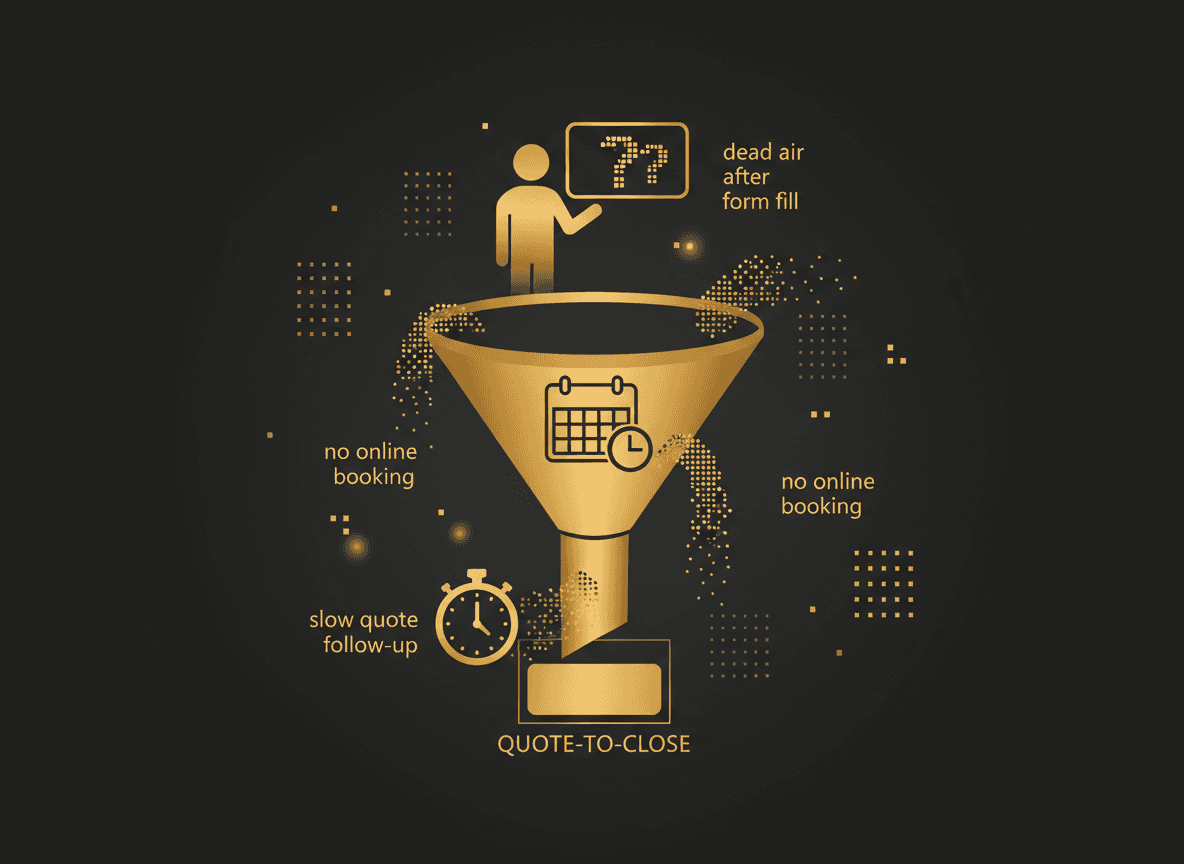
Someone fills out your "Request a Quote" form. What happens next? For most home services businesses: nothing, for hours.
No confirmation. No text. No "got it, we'll be in touch." The lead sits in an inbox while the homeowner keeps shopping — because to them, silence means you're not interested or not open.
The fix: an instant auto-response the second that form hits. A text and an email within 60 seconds. "Thanks Sarah — we got your request for the water heater replacement. Here's a link to grab an estimate slot, or reply here and we'll call you right now." That single message puts you ahead of nearly every contractor the homeowner is quietly waiting on.
Even when you do respond fast, you create friction. "When are you free this week?" starts a game of phone tag that drags for days.
Meanwhile the competitor sent a booking link and the homeowner picked a Tuesday 2 PM slot in ten seconds.
Give people a calendar. Let them book a site visit or estimate without talking to anyone. The easier you make it to say yes, the more yeses you get. A cleaning company that lets clients self-book walkthroughs will out-book one that plays voicemail tag every single time.
You did the site visit. You said "I'll send the quote over." Then it takes you three days because you're on a roof.
By day three the homeowner already signed with someone who handed them a clean quote before leaving the driveway. Speed at the estimate stage matters just as much as speed at the lead stage.
The fix: a quote template you can send from your phone same-day, plus an automated follow-up sequence. If they don't respond in 48 hours, the system pings them. Not you — the system. Most contractors quote once and go silent. The follow-up is where half the money is.
Once you're booking estimates fast, you'll hit the next problem: no-shows. People book, then ghost, and your tech burns a two-hour round trip for nothing.

For bigger jobs, secure the slot with a small deposit or a card on file. A homeowner who puts $50 down for a scheduled estimate shows up. A homeowner who books for free treats it like a maybe. This also filters tire-kickers so your calendar fills with people who actually intend to buy.
Here's the standard you're competing against, whether you like it or not:
None of this requires you to sit by your phone. It requires a system that responds while you're up a ladder or under a sink. That's the whole point — the fast contractor isn't faster because they're glued to their inbox. They built machinery that never sleeps.
The brutal truth: your competitors aren't better than you. They just answer first. Fix your response-and-booking window and you'll win jobs you're currently handing away for free.
You can't fix what you can't see. Most owners have no idea how long their actual lead response time is, how many form fills get zero reply, or how many estimates never get a second follow-up.
Run your free Revenue Code Diagnostic. It pinpoints exactly where your response-and-booking process is leaking jobs — the dead air, the missing booking link, the quotes that never get chased — so you know precisely what's costing you money.
Want us to build the whole system for you? Book a pricing call and we'll map the fix. Or read more breakdowns on how home services businesses stop handing revenue to faster competitors.
Most SaaS founders treat the free trial as a waiting room. The ones converting at 25% or higher treat it as a structured sales system. Here is how to build that system.
Read moreA product roadmap tells you what you are building. A revenue engine tells you whether it is making money. Most SaaS founders only have one of these, and it is the wrong one.
Read more