Blog - The latest articles and news
Stay up-to-date with the latest industry news as our marketing teams finds new ways to re-purpose old CSS tricks articles.
Stay up-to-date with the latest industry news as our marketing teams finds new ways to re-purpose old CSS tricks articles.
by Kingdom Kode Team, Digital Innovation

You raised on a pitch deck and a demo. Now a term sheet is close, and someone on the other side just asked for access to your systems. That's the moment most founders learn how to make my startup fundable is a question about infrastructure, not vibes — and their tech won't survive a serious look.
Here's the uncomfortable truth: investors stopped grading on charisma. A slick demo gets you the meeting. A clean tech foundation gets you the wire. The gap between those two is where deals die — or get repriced because the diligence team flagged "technical risk."
Early-stage due diligence used to be light. That's over. As checks get bigger and capital gets tighter, investors probe the boring stuff that predicts whether you can actually scale the money they give you.

Here's what they open up:
Most founders fail these questions not because their business is bad, but because they never built the plumbing. They optimized for shipping fast. Fair. But fast and fundable aren't the same thing.
Forget the 40-item checklist. Fundable tech comes down to three pillars. Get these right and you'll pass diligence. Miss them and no deck saves you.

One place where the truth lives. Customers, contracts, usage, revenue — all connected, all queryable, all owned by the company (not a person). When an investor asks "how many active customers do you have," you should have one answer, and it should take you ten seconds to pull.
A fitness startup doing $50k/mo that keeps clients in one spreadsheet, payments in Stripe, and churn "somewhere in Slack" doesn't have a system of record. It has three disconnected islands and no boat.
Money should move without a human babysitting it. Sign-up, billing, renewal, dunning, reporting — automated and instrumented. An investor doesn't just want to see revenue; they want to see that revenue is repeatable and observable. If getting paid depends on you personally chasing invoices, you don't have a business, you have a job with extra steps.
Every transaction and interaction should compound into an asset. The longer you operate, the smarter your system should get and the harder you should be to copy. Data you own and structure is the moat investors pay a premium for. Data trapped in tools you rent is a liability with a monthly fee.
Here's the sequence. Don't skip steps.
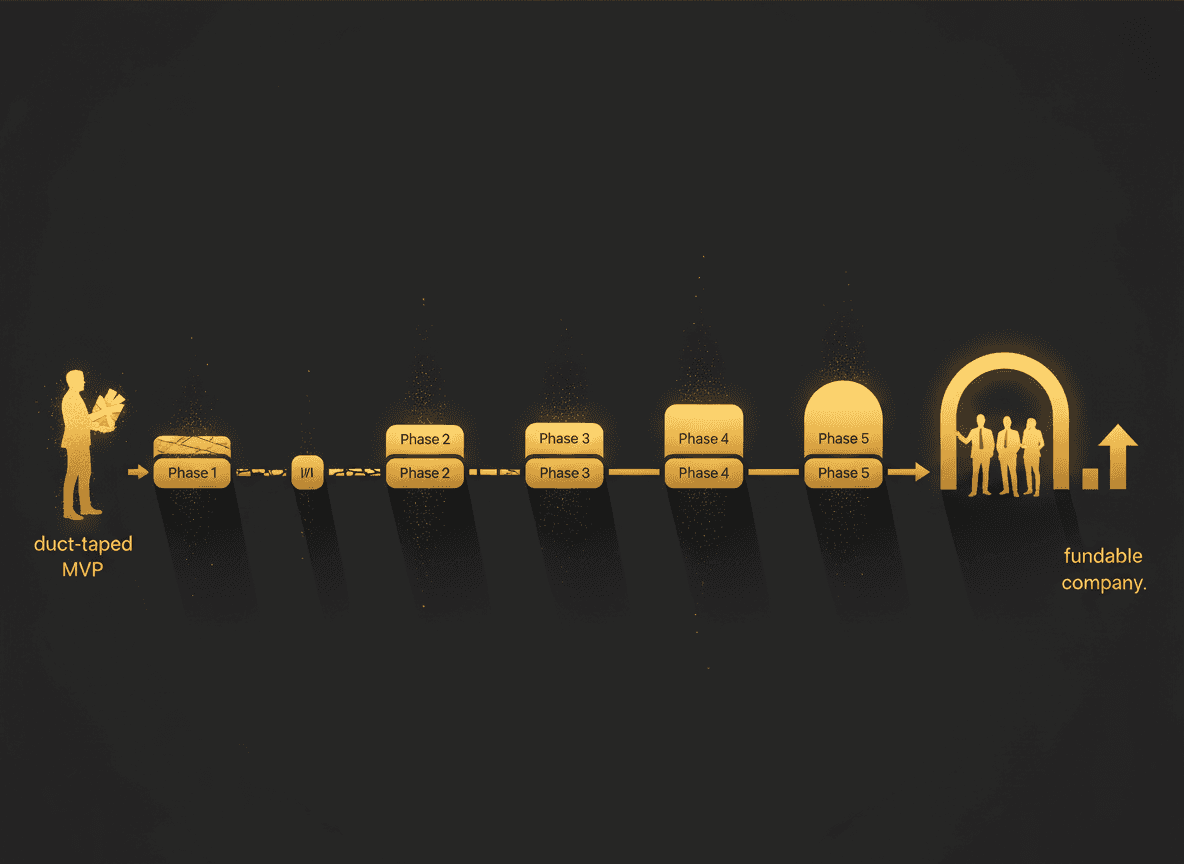
Phase 1 — Audit the wreckage. List every tool touching a customer or a dollar. Map where data enters, where it lives, and where it leaks. Most founders are stunned by how many disconnected tools they're running with zero connective tissue. You can't fix what you haven't mapped.
Phase 2 — Consolidate to a system of record. Pick or build the one place truth lives. Migrate the critical data. Kill the redundant tools. This alone answers half of diligence.
Phase 3 — Instrument the revenue engine. Automate billing and reporting so your metrics are pulled, not guessed. Make MRR, churn, and CAC live numbers, not quarterly archaeology projects.
Phase 4 — Build the moat. Structure your data so it compounds. Turn proprietary workflows into owned IP. This is what turns a "nice business" into a "fundable company."
Phase 5 — Package the story. A data room that a diligence team can navigate in an afternoon. Clean, documented, defensible. This is the difference between a fast "yes" and a slow "we have concerns."
Most founders try to do this the week before a raise. That's how you get caught. The roadmap takes months, not days — which is exactly why starting before you need it is the whole edge.
You can build this yourself. Plenty do. But if you're staring at a duct-taped stack and a fundraise on the calendar, guessing is expensive.
That's what our founder program exists for — taking founders from hacked-together MVP to infrastructure that survives scrutiny. We build the system of record, wire the revenue engine, and structure the data so diligence becomes a formality instead of a landmine. If that's the mile you're standing at, Apply to Zero-to-Hero.
But don't start with a call. Start with a map.
Before you fix anything, you need to know exactly where your tech and revenue systems will crack under investor pressure. That's what the diagnostic does — it shows you the gaps between what you have and what capital-ready looks like.
Run your free Revenue Code Diagnostic and get a clear read on where your startup stands before an investor does it for you.
Want more frameworks like this? Browse the blog or reach out directly.
Most SaaS founders treat the free trial as a waiting room. The ones converting at 25% or higher treat it as a structured sales system. Here is how to build that system.
Read moreA product roadmap tells you what you are building. A revenue engine tells you whether it is making money. Most SaaS founders only have one of these, and it is the wrong one.
Read more