Blog - The latest articles and news
Stay up-to-date with the latest industry news as our marketing teams finds new ways to re-purpose old CSS tricks articles.
Stay up-to-date with the latest industry news as our marketing teams finds new ways to re-purpose old CSS tricks articles.
by Kingdom Kode Team, Digital Innovation

The phone rings. You've got clippers in one hand and a client's head in the other. You can't answer. It rings out. That caller? They're already dialing the shop down the street. If you're wondering how to stop missing customer calls in your small business, start here: every unanswered ring isn't a missed call — it's a missed deposit. And you're bleeding them all day.
That's the whole problem. The calls are coming in whether you can pick up or not. The only question is who books them: you, or the next name on the list.
Most owners have no idea what missed calls actually cost. So let's put a number on it. The formula is dead simple:

Missed calls per week × close rate × average ticket = weekly leak.
Run it with a barbershop doing $30k/mo:
That's 15 × 0.50 × $45 = $337/week. Call it $1,350/month walking out the door. Over a year, that's more than $16,000 — enough to cover a second chair, or a full-time front desk you never hired.
Now run it for a home services business where the average job is $400. Ten missed calls a week, 40% close rate. That's $1,600 a week. You do the annual math. It's ugly.
The leak is invisible because it never shows up on a report. Nobody logs the customer who didn't leave a voicemail. That's exactly why it's one of the biggest holes in most SMB revenue — and the one owners almost never track.
Here's the uncomfortable truth: fewer and fewer people leave voicemails. When your call rings out, most callers just hang up and dial the next name on Google. They're not waiting around for you to call back.

Speed decides who wins. The business that responds first books the job. It's not the best barber or the cheapest plumber — it's the fastest responder. And "I'll call them back after this client" is a 2-hour delay. By then the appointment is booked somewhere else and the deposit is gone.
Voicemail isn't a safety net. It's a leak with a professional-sounding greeting.
You don't need to answer every call. You need a system that captures every caller. Three moving parts:
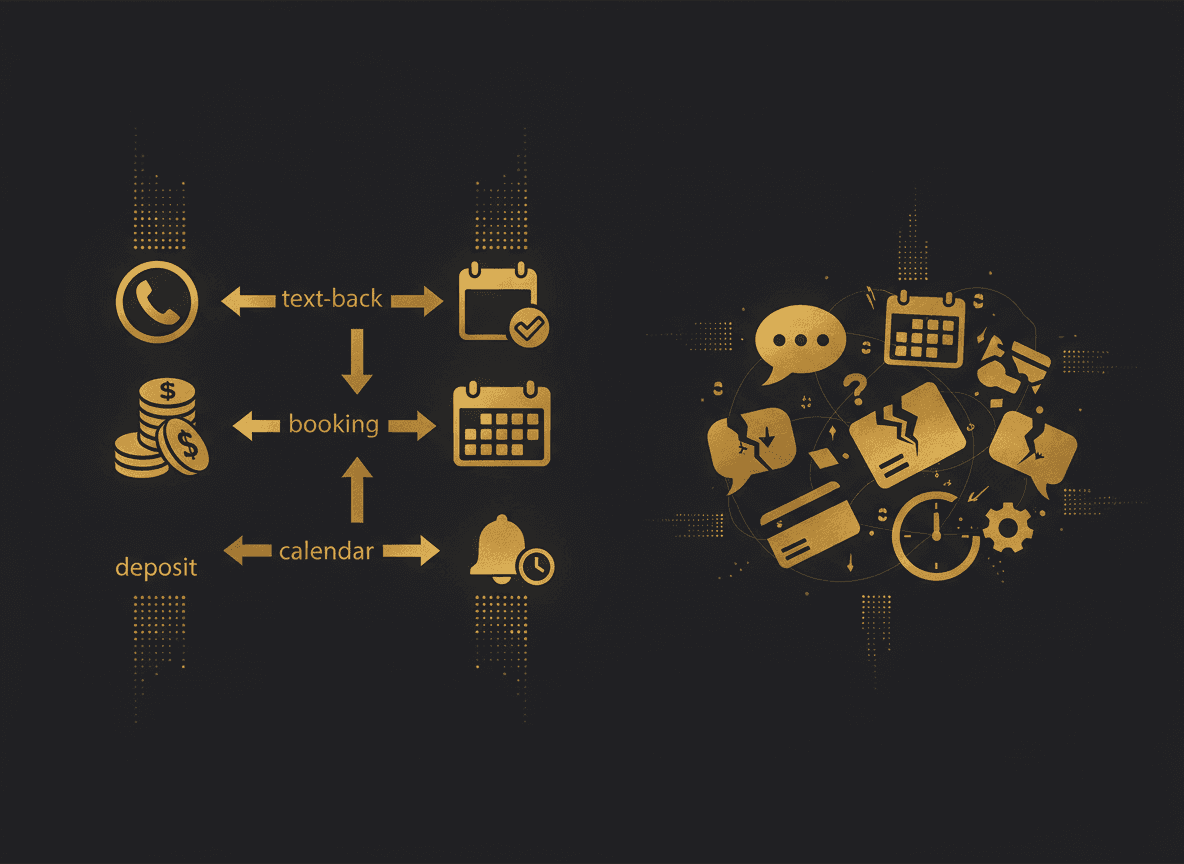
Half your missed calls happen when you're closed or heads-down. A booking page lets the customer self-serve — pick a slot, put down a deposit, done. No phone tag. The appointment lands on your calendar while you sleep. This alone recovers the after-hours calls you never even knew you lost.
When you can't pick up, an automatic text fires within seconds: "Sorry we missed you — this is Mike's Barbershop. Want to grab a spot? Book here: [link]." You just turned a hang-up into a warm lead holding a booking link. For most service businesses, it's one of the highest-return automations you can install for the effort it takes.
Every web form, DM, and inquiry gets an instant reply — automated, not "when you get to it." The goal is a response inside 5 minutes, every time, no exceptions. Speed is the moat. Automate it and you never lose on speed again.
You can DIY this. A booking app here, a texting tool there, a Zapier chain praying nothing breaks. It works until it doesn't — the tools don't talk, deposits don't collect, and the text-back fires but points to a booking page that's out of sync with your calendar. Now you've got double-bookings and a customer standing at a locked door.
An integrated Revenue Engine connects all three into one flow: ring → text-back → booking → deposit → calendar → reminder. One system. No gaps. Every ring becomes a booked, paid appointment instead of a coin flip.
The difference between duct tape and a Revenue Engine is the difference between plugging the leak and actually keeping the water. Most owners don't need more marketing — they need to stop losing the customers who are already calling.
Do the math on your own numbers before you do anything else. Missed calls × close rate × average ticket. If the number scares you, good — now you know what the fix is worth.
Run your free Revenue Code Diagnostic. It pinpoints exactly where your bookings are leaking — missed calls, slow response, no deposits — and shows you what plugging each hole is worth in real dollars. No pitch, just the diagnosis.
The calls are coming in whether you answer or not. Might as well book them. Want more breakdowns like this? Head to the blog.
Most SaaS founders treat the free trial as a waiting room. The ones converting at 25% or higher treat it as a structured sales system. Here is how to build that system.
Read moreA product roadmap tells you what you are building. A revenue engine tells you whether it is making money. Most SaaS founders only have one of these, and it is the wrong one.
Read more