Blog - The latest articles and news
Stay up-to-date with the latest industry news as our marketing teams finds new ways to re-purpose old CSS tricks articles.
Stay up-to-date with the latest industry news as our marketing teams finds new ways to re-purpose old CSS tricks articles.
by Kingdom Kode Team, Digital Innovation

You booked the slot. They didn't show. The chair sat empty for 45 minutes and you still paid your staff, your rent, and your card processor for the privilege. If you've ever googled how to stop no-shows at my business, it's because that empty chair is quietly eating your revenue — and you've never once put a dollar figure on it.
That's the question every owner eventually asks, usually right after a brutal Saturday. Depending on the niche, it's common to see 10-30% of booked revenue walk out the door to no-shows and last-minute cancellations — and most owners are shocked when they finally run their own number.
Let's fix that first. Then let's kill it.
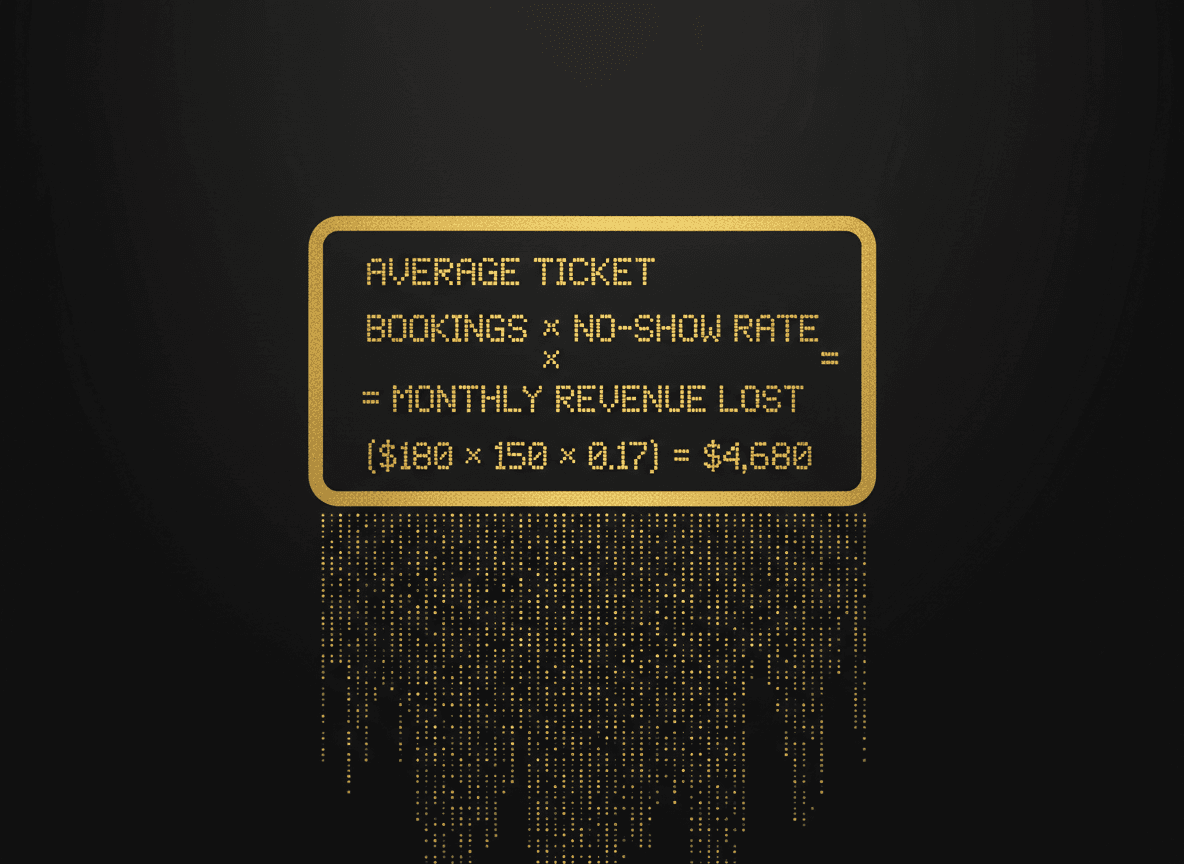
Grab a calculator. This takes 60 seconds.

Now: 120 bookings × 15% = 18 empty slots a week. 18 × $60 = $1,080 a week. That's $4,680 a month. $56,160 a year walking out the door before you've paid for a single ad.
A barbershop doing $30k/mo at a 20% no-show rate is leaking around $6,000 every month. A dental clinic with a $250 average and 40 bookings a week at 12% is bleeding over $5,000 a month.
Run your real numbers. The figure is almost always bigger than owners guess — because the slot doesn't just cost you the missed ticket. It costs you the customer you turned away who wanted that time.
The standard defense is a front-desk person phoning to confirm the day before. Here's why it fails:
Confirming isn't the same as committing. You need the customer to have something on the line, and you need the busywork off your staff's plate.
The single biggest lever. When someone puts $10-$25 down to hold a slot, no-show rates drop hard — because now skipping costs them money.

You don't need to charge the full ticket. A partial deposit that applies to the final bill does the psychological work. Rules that work:
Owners worry deposits scare customers off. In practice, the people a deposit filters out are exactly the ones who were going to flake anyway. You trade a few tire-kickers for a calendar that's actually real.
Stop calling. Automate it. A reminder sequence fires the same way every time, whether it's a slow Tuesday or your busiest Saturday.
A sequence that works looks like this:
Every message includes a one-tap way to cancel or move. Sounds backwards, but you want the flake to cancel at 24 hours instead of ghosting at zero — because 24 hours gives you time to refill the slot. Which is the next piece.
This is the part almost nobody has, and it's where the money is.
When a booked customer cancels, the slot shouldn't just go dark. It should instantly offer itself to your waitlist. Someone who wanted 3pm Friday gets an automatic text: "A 3pm Friday slot just opened — reply YES to grab it." First reply wins.
Now a cancellation isn't lost revenue. It's a slot that resells itself in minutes, with zero effort from your front desk. Deposits reduce the cancellations. Reminders push flakes to cancel early. The waitlist recaptures the ones that slip through. Three layers, one outcome: a full calendar.
Here's the trap. You buy a reminder app. Then a separate deposit tool. Then a waitlist plugin. Now you've got three systems that don't talk to each other, three monthly fees, and a front desk copying data between them.
When the deposit tool doesn't know a slot got cancelled, the waitlist never fires. When the reminder app doesn't know a deposit was paid, it can't say so. The gaps between tools are exactly where no-shows live.
The fix has to be one integrated booking system where the deposit, the reminders, and the waitlist all share the same calendar. Booking triggers the deposit. Cancellation triggers the waitlist. Everything downstream just works because it's all the same engine — not a stack of apps held together with hope.
You now have the diagnosis: run the calculator, and if you're losing four or five figures a month to empty slots, the fix is deposits + automated reminders + an auto-filling waitlist, built into one system instead of bolted on.
Implementing it cleanly — so it fits your services, your policies, and your customers without tanking your bookings — is the part we handle.
Run your free Revenue Code Diagnostic and we'll show you exactly where your booking revenue is leaking and what it's costing you every month. No pitch, just the number and the plan.
Want to see how the fix maps to your setup? Book a pricing call or browse more breakdowns on the blog.
Most SaaS founders treat the free trial as a waiting room. The ones converting at 25% or higher treat it as a structured sales system. Here is how to build that system.
Read moreA product roadmap tells you what you are building. A revenue engine tells you whether it is making money. Most SaaS founders only have one of these, and it is the wrong one.
Read more